
UK Formal Letter Format: Templates, BBC Etiquette and Tracked Posting
Published 17 September 2026
Use UK block layout: sender address top right, date beneath it, recipient address on the left, salutation, body, sign-off and a handwritten signature. If you know the recipient’s name, write “Dear Mr Smith,” and close with “Yours sincerely,”. If you don’t, write “Dear Sir or Madam,” and close with “Yours faithfully,”. Set the page as A4, keep the body left-aligned, and use single spacing throughout.
TL;DR:
- Formal UK letters should follow a block layout with the sender’s address top right and the recipient’s address on the left, two lines below the date.
- Use a familiar salutation like “Dear Mr Smith” with “Yours sincerely” unless the recipient is unknown, in which case “Dear Sir or Madam” and “Yours faithfully” are correct.
- Structure the body with a clear opening statement, facts without editorialising, evidence attached, and a specific request with a reasonable deadline.
- Use A4 size paper, a 11-12pt Times New Roman or Arial font, wide margins, single spacing within paragraphs, and leave space for a handwritten signature.
- When mailing, verify recipient details, include references and enclosures, and choose tracked or guaranteed delivery services for legal or deadline-sensitive correspondence.
PostRightpostright.co.ukSend Your Formal Letter CorrectlyPostRight prints, envelopes and dispatches UK formal letters through Royal Mail, with tracked services available for important correspondence.Send a legal letter
Table of Contents
- Where do the sender address, date and recipient go?
- Which salutation and sign-off should you use?
- How should you structure the body of the letter?
- What paper, font and margins does a formal letter need?
- Do you need a subject line or reference number?
- What tone and language suit UK formal correspondence?
- What do enquiry, complaint and job-application letters look like?
- What should you check before you post the letter?
- Where can you find reliable UK letter templates?
- A simpler way to get your letter printed and posted correctly
- Sources
- FAQ
Where do the sender address, date and recipient go?
The sender’s address sits top right, unless you’re using headed paper, in which case you can omit it entirely and let the letterhead do the work. Each line of the address runs on its own row, with the postcode on the final line and no full stops between lines.
The date follows directly beneath the sender’s address, right-aligned to match. Write it in full: Day Month Year, not the American month-first order. Some UK guides allow left-aligned dates if the whole letter is left-aligned, but keeping the sender block and date together on the right reads as more conventional and matches long-standing UK business letter formatting.
The recipient’s address goes left-aligned, two lines below the date (or two lines below the sender block if you’ve skipped the date, though you shouldn’t). A few practical points worth flagging:
- If posting in a window envelope, line up the recipient address with the visible window before you print, or the Post Office may struggle to read it through the aperture.
- Include the recipient’s job title or department on its own line if you have it, this often determines who actually opens the letter first.
- Leave the sender address off entirely if PostRight or another printing service is dispatching on your behalf, since the return address usually appears on the envelope instead.
Which salutation and sign-off should you use?
The rule is simple and it doesn’t change: a named recipient gets “Dear Mr Smith,” and closes with “Yours sincerely,”. An unknown recipient gets “Dear Sir or Madam,” and closes with “Yours faithfully,”. Mixing the two, for instance opening with “Dear Sir or Madam” and closing “Yours sincerely,” is one of the most common errors in UK correspondence, and it undermines the letter’s formality according to BBC Bitesize’s guidance.
A few finer points make the difference between competent and clumsy:
- Use a forename only if you already correspond informally with the recipient; otherwise “Dear Mr Smith,” or “Dear Dr Patel,” is safer.
- Use “Ms” by default for women unless you’ve been told they prefer “Mrs” or “Miss”, this avoids assumptions about marital status.
- Always end the greeting and closing with a comma, not a colon or full stop.
Pro Tip: Before defaulting to “Dear Sir or Madam,” spend two minutes checking the organisation’s website or calling to ask for a name. Usingenglish notes that avoiding generic salutations improves the odds your letter reaches the right desk first time, rather than sitting in a general inbox.
How should you structure the body of the letter?
Open with a single-line sentence stating why you’re writing. “I am writing to request a refund under Section 75 of the Consumer Credit Act 1974” tells the reader exactly what’s coming, before you’ve explained a single detail.
From there, build the case in three tight stages:
- State the facts: dates, order numbers, what happened, without editorialising.
- Set out the evidence: what you’ve attached, what was agreed, what the recipient failed to do.
- Ask for the outcome you want, with a deadline where one is reasonable (“I expect a response within 14 days”).
Close with a polite line before the sign-off, something like “I look forward to your prompt reply,” then leave four clear lines for a handwritten signature above your typed name. A signed original, even scanned or posted rather than handed over, still reads as more serious than an unsigned printout.
Pro Tip: If you need a recipient to countersign or return a signed PDF copy before you post the original, a tool like FlowPDF lets you sign documents online without uploading them to a third-party server first.
What paper, font and margins does a formal letter need?
Use standard UK business letter size in portrait orientation, typically A4.
Fonts matter more than people assume. IONOS’s business letter guidance recommends Times New Roman or Arial at 11 to 12pt, with the whole body left-aligned rather than justified.
- Set margins wide enough to look balanced and professional without wasting space.
- Use single line spacing within paragraphs, with one blank line between each paragraph rather than an indent.
- If you’re writing on behalf of a company, include your Companies House registration number in the footer where relevant, and label any enclosures clearly beneath your signature block.
Debretts, the UK’s long-standing authority on etiquette, still argues that headed paper adds a degree of gravitas that a plain printout can’t match, particularly for complaints or legal notices where you want to be taken seriously from the first glance.
Do you need a subject line or reference number?
A subject line isn’t compulsory, but it helps enormously with routing, especially inside larger organisations where post gets sorted by department before anyone reads it.
- Place the subject line two lines below the recipient’s address, either bold or centred, and keep it to one line: “Re: Account Number 4471829, Overpayment Claim.”
- Use “For the attention of [Name/Department]” directly above the salutation if you need the letter to reach a specific team rather than a general postbag.
- List enclosures beneath your signature as “Enc: [item]”, numbering each one if there’s more than one, so the recipient can check nothing’s missing.
What tone and language suit UK formal correspondence?
Formal English favours direct, neutral phrasing over anything emotional or colloquial. A complaint letter that says “I am dissatisfied with the service received on 4 March” carries more weight than one that vents frustration, even when the frustration is entirely justified.
Address professional titles correctly, “Dr”, “Prof” or “Rev” where they apply, and default to “Ms” for women unless instructed otherwise. “Kind regards,” is acceptable for slightly less formal business correspondence, such as a follow-up email, but it has no place closing a legal notice or a letter before action, where “Yours sincerely,” or “Yours faithfully,” remains correct.
- Formal: “I would be grateful if you could confirm receipt of this letter within seven days.”
- Less formal: “Let me know when you get this, cheers.”
The gap between those two lines is the difference between a letter a recipient takes seriously and one they file without action.
What do enquiry, complaint and job-application letters look like?
A short enquiry letter needs little more than a clear opening line, one paragraph of context, and a direct question: “Could you confirm your current lead time for [product/service]?”
A complaint letter follows the same body structure covered earlier, facts, evidence, requested outcome, but should always cite the relevant right where one exists. For a faulty purchase paid by credit card, that might mean referencing Section 75 of the Consumer Credit Act 1974 directly in your opening paragraph. PostRight’s formal complaint letter template sets out this structure with placeholders you can drop straight into.
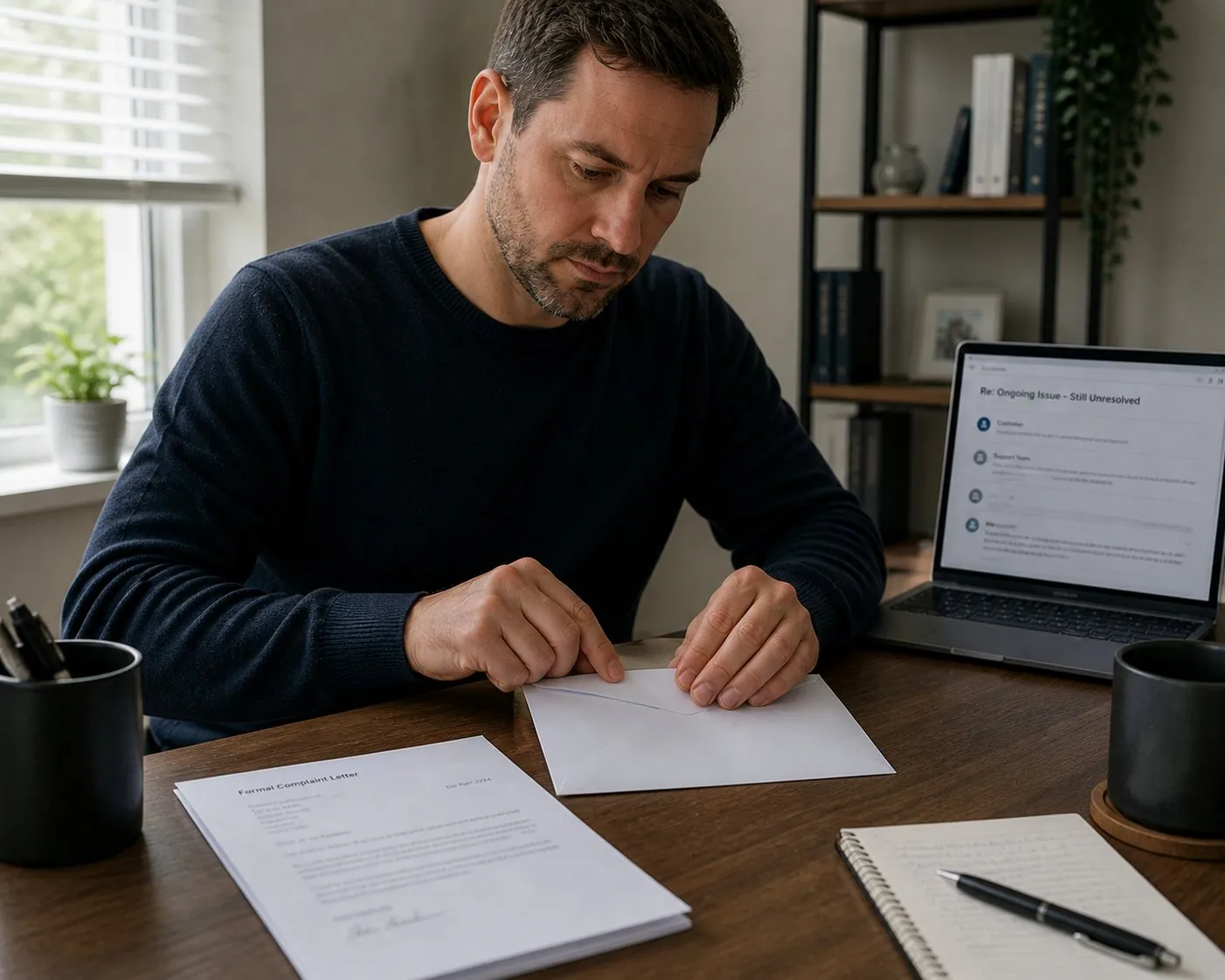
A job-application letter swaps the complaint’s evidence section for a short paragraph on relevant experience, then closes by referencing an enclosed CV: “Please find my CV enclosed for your consideration.”
For anything heading towards a dispute rather than a request, a proper letter before action needs the legal citation and claim reference stated plainly near the top, not buried in the closing paragraph.
What should you check before you post the letter?
Run through this list before the envelope goes anywhere near a postbox:
- Confirm the recipient’s name, title and job function are correct, and that “Dear Sir or Madam,” pairs with “Yours faithfully,” (never with “Yours sincerely,”).
- Check the date, postcode and any reference or account numbers are accurate and match your records.
- Count the pages, list every enclosure, and sign by hand wherever the original copy allows it.
For anything with a legal deadline, a refund claim, a Section 75 dispute, a complaint with a response window, proof of delivery isn’t optional, it’s the difference between a letter that holds up and one that doesn’t. That’s when Tracked 48, Tracked 24 or Special Delivery Guaranteed earn their cost over ordinary post.
Pro Tip: Special Delivery Guaranteed is the only Royal Mail service with an actual delivery guarantee, next working day by 1pm. Every other tracked service, including Tracked 24, is an aim rather than a promise, so build in a buffer if you’re working to a legal deadline.
Where can you find reliable UK letter templates?
PostRight maintains a set of ready-to-edit UK templates covering everything from consumer complaints to letters before action, and can print and post the finished letter by Royal Mail the same working day. PostRight isn’t a law firm and does and doesn’t provide legal advice, it prints and posts what you write. For anything needing proof of delivery, choose Tracked 48, Tracked 24 or Special Delivery Guaranteed rather than Standard second class post. For layout and etiquette conventions beyond this guide, BBC Bitesize, Debretts and GOV.UK’s published correspondence examples remain solid reference points.
A simpler way to get your letter printed and posted correctly
There are other routes to a properly formatted letter, a word processor template you build yourself, a print shop, a trip to the post office with stamps and an envelope, and each one works. PostRight exists for people who’d rather skip the printer, the stamps and the queue entirely. You write your letter, upload a finished PDF or Word document, or start from one of a set of pre-built UK legal templates, and it’s printed on A4 and posted by Royal Mail the same working day for orders placed before 2.30pm UK time, Monday to Friday.
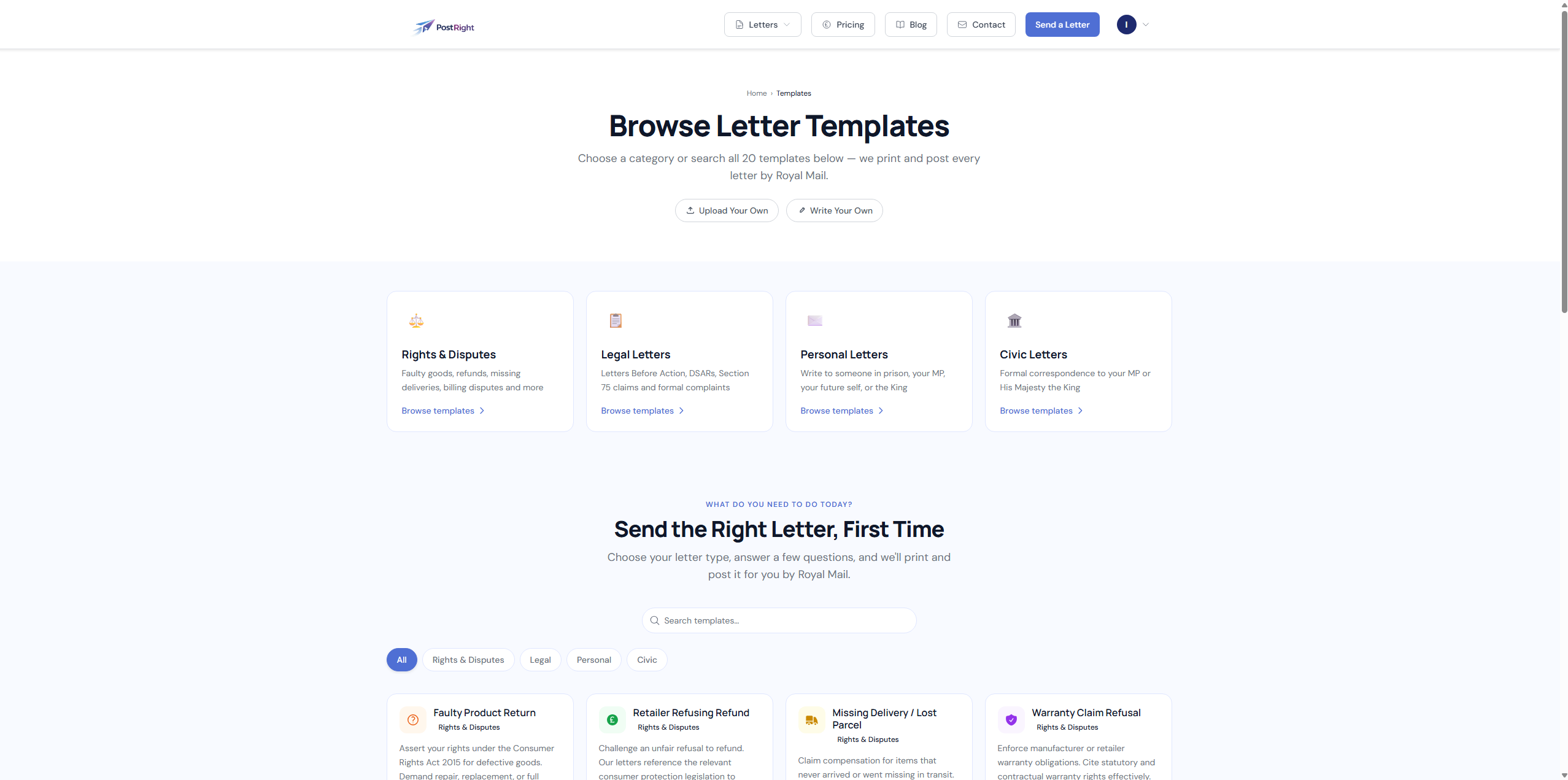
Pricing per letter typically varies by service type, from options offering tracking, signature on delivery, and compensation guarantees. Exact prices depend on chosen delivery level and services provided. If your letter is a legal notice, a DSAR request, or carries a refund or complaint deadline, choose a tracked tier so you have proof it arrived. Head to the PostRight templates page to edit a ready-made template or upload your own finished letter, then pick the delivery tier that matches what’s at stake.
Sources
- How to write a formal letter - BBC Bitesize
- Business letter template and formatting guidance — IONOS digital guide
- Business etiquette — Debretts
- How to format a UK business letter — Daily Writing Tips
FAQ
How do you structure a formal letter in the UK?
Use block layout: sender address top right, date beneath it, recipient address on the left, then salutation, body paragraphs, sign-off and a handwritten signature. Match your salutation and sign-off correctly, “Dear Sir or Madam,” with “Yours faithfully,” or a named greeting with “Yours sincerely,”.
What is the correct format for a formal letter?
A4 portrait paper, left-aligned body text, a font like Times New Roman or Arial at 11 to 12pt, and margins of roughly 2 to 2.5cm on all sides. The date is written Day Month Year, for example “20 March 2026”.
What is the format of an English formal letter?
It follows the same UK block layout as any formal letter: sender details top right, date, recipient address left-aligned, a matched salutation and sign-off, and a signed closing. There’s no separate “English” format distinct from the standard UK convention.
Do I put England or the UK on my address?
For a domestic letter, the county or city and postcode are what actually route it, “England” or “UK” isn’t required on the address itself. Include “United Kingdom” only if the letter is being sent from or expected to travel internationally.
What price should I expect to send a formal letter through PostRight?
PostRight’s Standard letter starts from £2.49, with tracked options including Tracked 48 and Signed For at £7.99, Tracked 24 at £8.99, and Special Delivery Guaranteed at £18.99 for next-working-day delivery with proof.
Recommended
- Formal Complaint Letter UK
- Letter Before Action UK
- Rights & Disputes Letters UK
- Letter Before Action Template UK Guide
This article is for general information about UK law and consumer rights and does not constitute legal advice. Laws and Royal Mail prices can change; details were correct at the time of writing. PostRight Ltd is not a law firm. If your situation is complex or the sums involved are significant, consider taking advice from a solicitor or a free service such as Citizens Advice.