
Avoid Missed Legal Deadlines: Second Class Delivery Time in the UK
Published 13 September 2026
Royal Mail aims to deliver Second Class letters within three weekdays, but this is a target rather than a guaranteed delivery time. Non-First Class post now moves on an alternate-weekday delivery pattern, so the day you post genuinely changes when it lands. If you’re sending anything with a legal deadline attached, don’t gamble on Second Class alone.
TL;DR:
- Second Class delivery usually takes two to three working days, but actual times can extend beyond that due to staffing, weather, or regional delivery patterns.
- Moving to an alternate-weekday schedule means Second Class letters arrive every other weekday, potentially adding a day for rural or Friday posts.
- Royal Mail’s three-day target is an aim, not a guarantee, and delays are common around seasonal peaks, staff shortages, or regional rollout issues.
- For legally sensitive or time-critical mail, tracking, proof of posting, and tracking services significantly reduce the risk of loss or late delivery.
- The only Royal Mail service backed by a legal contract is Special Delivery, which guarantees next-day delivery and should be used for deadlines with legal consequences.
PostRightSend Formal Letters Without the Post OfficePostRight prints and dispatches your UK legal correspondence through Royal Mail, with tracked delivery options for time-sensitive letters.Send a letter with PostRight
Table of Contents
- What does the Second Class delivery time actually cover?
- How does the alternate-weekday delivery schedule work?
- Why does Second Class post sometimes take longer than expected?
- When should you upgrade from Second Class post?
- What to do if your Second Class letter is late or missing
- What PostRight sees from senders who rely on Second Class
- Our take: stop treating “aim” as a promise
- Need certainty rather than an aim? Here’s the faster route
- Sources
- FAQ
What does the Second Class delivery time actually cover?
Royal Mail’s own guidance says Second Class letters usually take 2 to 3 working days, and the official aim is delivery within three weekdays of posting. That word “aim” matters more than most people realise. It’s a target Royal Mail works towards, not a contract it has to honour. The only Royal Mail product with a genuine contractual guarantee is Special Delivery.
For non-tracked Second Class items, compensation if something goes wrong is limited and capped at a fixed amount. Royal Mail’s Second Class product page prices letters up to 100g from 91p, and points senders towards tracked or guaranteed options when they need proof or faster delivery. Here’s what actually falls under standard Second Class cover:
- Letters and large letters sent without tracking
- Compensation capped at a modest fixed amount, not the item’s real value
- No signature, no tracking number, no delivery confirmation
- No route to prove a specific delivery date if a dispute arises
If losing a letter would cost you more than that capped compensation, or you need proof it arrived, Second Class on its own won’t cover you.
How does the alternate-weekday delivery schedule work?
Royal Mail has moved non-First Class letters, including Second Class, to an alternate weekday delivery pattern rather than delivering every day. In practice, this means your local delivery office visits addresses on Second Class rounds every other weekday, not five days a week. Citizens Advice confirms that Second Class letters now arrive on alternate weekdays, Monday to Friday, while parcels and some other services still run daily.
Here’s roughly how posting day maps to expected delivery under the new pattern:
| Posted on | Typical delivery window |
|---|---|
| Monday | Wednesday to Thursday |
| Tuesday | Thursday to Friday |
| Wednesday | Friday to Monday |
| Thursday | Monday to Tuesday |
| Friday | Tuesday to Wednesday (next week) |
Post on a Friday and there’s no Saturday collection round to catch it early, so it effectively waits until the following week’s cycle begins. Weekend posting boxes still get emptied, but the alternate-day rhythm means a Friday letter can lose an extra day compared with a mid-week one.
Pro Tip: During the rollout, add a day of slack to any estimate, especially for rural or semi-rural delivery offices where the new pattern is still bedding in.
Why does Second Class post sometimes take longer than expected?
Ofcom’s regulatory framework requires 95% of Second Class mail to arrive within three working days. That’s a reliability target, not a universal outcome, and the gap between the target and what actually happens on a given week can be wider than senders expect.
Several things routinely push delivery outside the aim:
- Staff shortages or sickness at a specific local delivery office
- Seasonal surges, particularly around Christmas and the January bill run
- Uneven rollout of the alternate-weekday schedule between regions
- Weather disruption affecting road and rail transport
Analysts tracking the network’s performance advise treating Royal Mail’s posted timescales as targets rather than guarantees, and recommend planning around the posting-day table above rather than a flat “two to three days” assumption. Guidance on the transition also suggests building in extra buffer while the new schedule settles in, particularly for addresses outside major towns.
If you’re posting something time-critical, the rule of thumb is simple: assume the slower end of the window, not the faster one, and check with your local Post Office if a specific delivery office is known for delays.
When should you upgrade from Second Class post?
Second Class is fine for a birthday card, an invoice you’re not chasing urgently, or a letter where a day or two either way changes nothing. It’s the wrong choice the moment a date matters legally.
Think about upgrading in these situations:
- Court papers or tribunal deadlines — a missed date can affect your case regardless of why the post was late.
- Section 21 or Section 8 tenancy notices — timing often determines whether the notice is valid.
- Contractual deadlines, such as a Section 75 claim or a formal complaint with a response window.
- Anything where you might later need to prove exactly when it was sent and received.
Tracked services close that gap. Tracked 48 and Tracked 24 both provide a tracking number, delivery notifications, and higher compensation than standard Second Class if something goes wrong. Special Delivery remains the only Royal Mail service backed by a genuine contractual next-day guarantee, which is why it’s the right call when a missed deadline carries real legal consequences.
Pro Tip: If you’re weighing up cost against risk, ask yourself what it would cost you if the letter simply vanished. If the answer is “quite a lot,” pay for tracking.
What to do if your Second Class letter is late or missing
First, don’t panic before Royal Mail’s own backstop window has passed. Second Class letters are officially considered lost only once they’re significantly beyond the three-weekday aim, so give it time before assuming the worst.
Once that window has passed:
- Check with the recipient directly. It’s often already arrived and just wasn’t mentioned.
- Look for any tracking reference, if you paid for a tracked service.
- Gather your proof of posting, receipt, and a copy of the letter itself before contacting Royal Mail.
- Submit a formal complaint through Royal Mail’s customer service channels, quoting dates and reference numbers.
If a complaint needs escalating, or you’re chasing compensation, a clearly written complaint letter that lays out dates, evidence and the outcome you want tends to get taken more seriously than a phone call.
What PostRight sees from senders who rely on Second Class
We deal with people posting formal and legal letters every day, and the pattern is consistent: senders who need genuine peace of mind choose Tracked 48 or Tracked 24 over standard Second Class, because signature confirmation on ordinary Signed For post can be unreliable.
Every PostRight order gets a PDF copy by email and order status updates, and tracked services carry a full Royal Mail tracking number. That paper trail matters when a court, landlord, or insurer asks for proof. Orders placed before our 2:30pm cutoff go out with Royal Mail the same working day, Monday to Friday, which matters if you’re overseas and racing a UK deadline.
Our take: stop treating “aim” as a promise
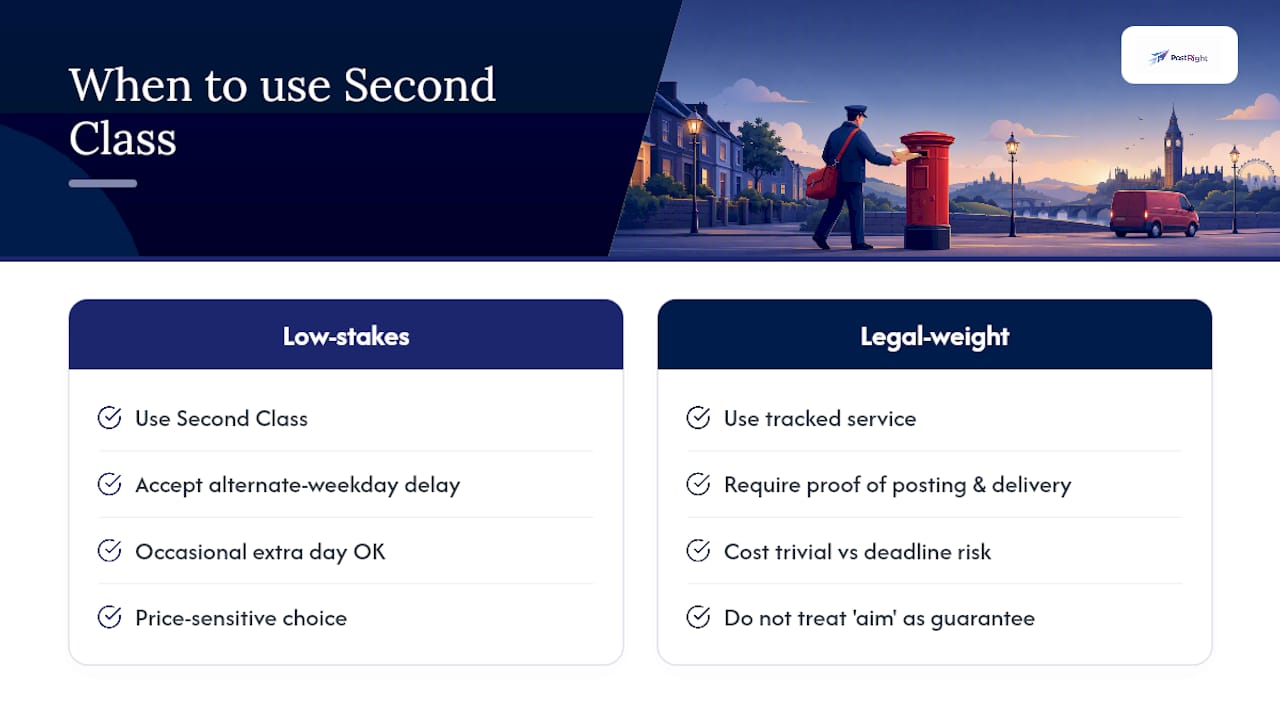
The single most common mistake we see is senders reading Royal Mail’s three-weekday aim as though it were a delivery contract. It isn’t, and the distinction between an aim and a guarantee is doing more legal work than most people realise. Conventional advice tends to stop at “post it a few days early.” That’s fine for a greetings card. It’s not remotely good enough for a Section 21 notice or a court filing, where the burden of proving when something arrived can sit with you.
What the evidence actually supports is a two-tier approach. Use Second Class for genuinely low-stakes post, and accept the alternate-weekday schedule will occasionally add a day you didn’t plan for. But the moment a date has legal weight, the calculation changes entirely: the cost difference between Second Class and a tracked service is trivial next to the cost of an unproven deadline. Prioritise proof of posting and proof of delivery before you prioritise price. That’s the shift most senders still haven’t made.
— Joshua
Need certainty rather than an aim? Here’s the faster route
PostRight is the alternative to queuing at a Post Office or hoping a Second Class stamp lands on time. You write or upload your letter online, choose Tracked 48, Tracked 24 or Special Delivery, and it’s printed, enveloped and handed to Royal Mail the same working day if you order before 2:30pm on a weekday.

That matters most when a deadline is fixed. Rather than trusting an aim, you get a Royal Mail tracking number on tracked services, a PDF copy of exactly what was sent, and order status updates throughout. For anyone dealing with a tenancy notice, Section 75 claim or formal complaint, 21 pre-built legal templates are ready to personalise. Do bear in mind that once Royal Mail has collected your letter, it can’t be recalled or refunded, so double-check the address and template before you confirm. If timing matters, start your letter now on PostRight and pick the delivery tier that matches what’s at stake.
Sources
- Royal Mail weekday and weekend delivery times
- Ofcom: Reforming the postal service so it delivers what people need
- Royal Mail delivery times: what to expect in 2026 | Ship24
- Check Royal Mail collection and delivery times - Citizens Advice
FAQ
How long should Second Class post take in the UK?
Royal Mail aims to deliver Second Class letters within three weekdays, usually described as 2 to 3 working days, though the alternate-weekday schedule means the exact day depends on when you posted.
What are the typical delays for Second Class post?
Delays usually stem from staffing gaps at a local delivery office, seasonal surges around Christmas and January, or uneven rollout of the alternate-weekday pattern in certain regions.
Why is Royal Mail taking so long with some letters?
Royal Mail’s three-weekday aim is a target rather than a guarantee, and Ofcom’s own reliability goal only requires 95% of Second Class mail to arrive within that window, meaning a small share will always run over.
How late can a postman deliver?
Delivery hours vary by round and depot, but Royal Mail’s guidance says timing depends on the service chosen and local delivery patterns, so there’s no single fixed cut-off time nationwide.
Is Second Class post ever a guaranteed delivery date?
No. Special Delivery is the only Royal Mail service with a genuine contractual next-day guarantee; Second Class, First Class and tracked services all operate on an aim rather than a promise.