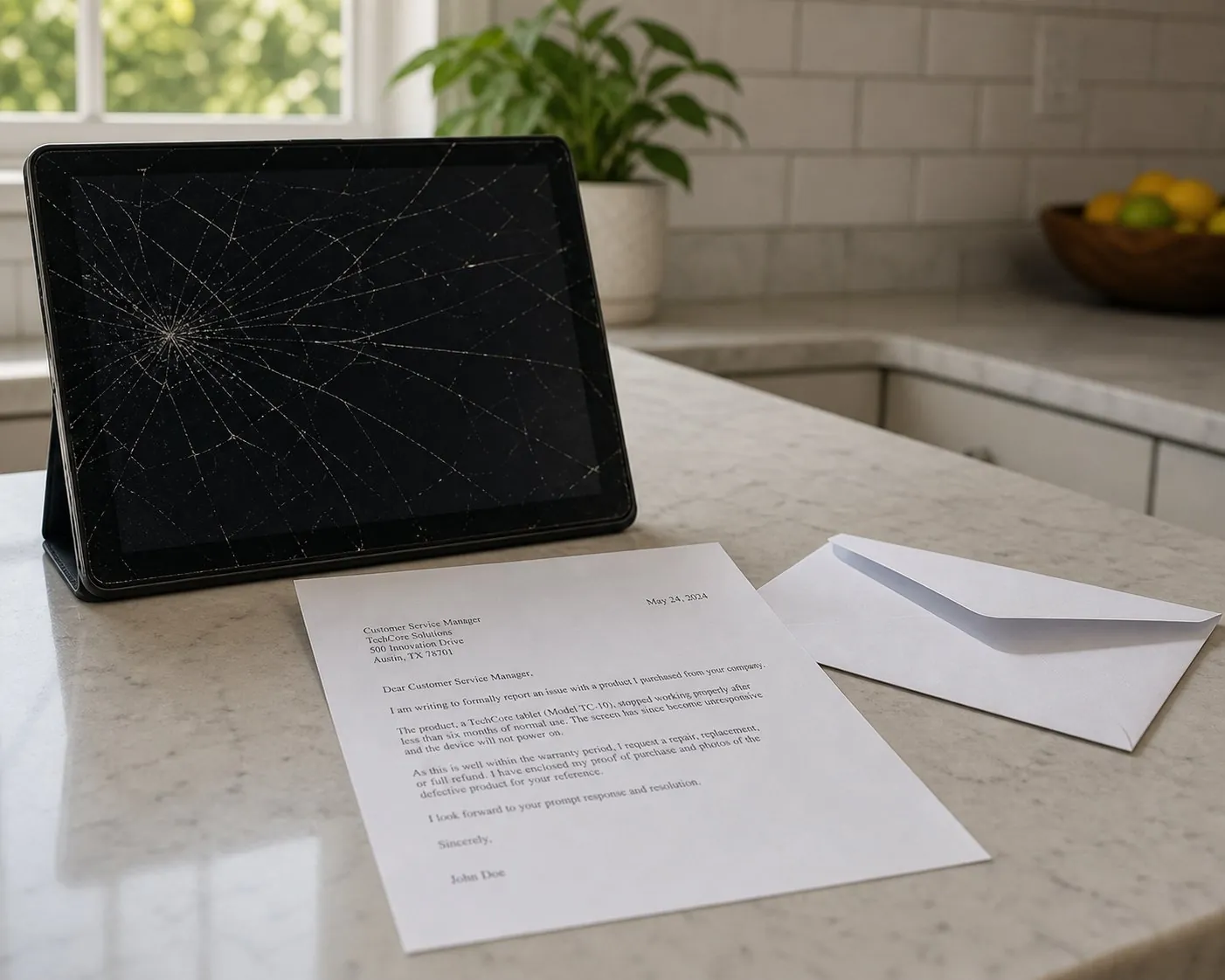
Faulty Goods Refund Letter That Gets Action

Published 23 March 2026

Faulty Goods Refund Letter That Gets Action

A retailer is often full of apologies right up to the point where you ask for your money back. That is where a clear faulty goods refund letter matters. If your emails have been ignored, or you keep getting pushed towards a repair you do not want, a formal written letter can make your position much harder to brush aside.

For UK consumers, the issue is not just whether an item is broken. It is whether the goods meet the standards required by the Consumer Rights Act 2015. Goods should be of satisfactory quality, fit for purpose, and as described. When they are not, the remedy depends on timing, the nature of the fault, and what has already happened between you and the seller.

When a faulty goods refund letter is the right next step

A formal letter is useful when the retailer has stopped being straightforward. That often happens after a few rounds of customer service messages, especially where the business keeps repeating policy wording instead of dealing with your legal rights.

If you bought something and it arrived damaged, stopped working quickly, or was clearly not as described, you may have a valid claim. The key point is that your contract is with the retailer, not the manufacturer. A shop cannot simply tell you to contact the brand and wash its hands of the matter.

Timing affects what you can ask for. If you are within 30 days of receiving the goods, you may have a short-term right to reject and claim a full refund. After that, the retailer may usually offer a repair or replacement first. If that repair or replacement fails, takes too long, or causes significant inconvenience, you can often move on to a price reduction or final right to reject.

That means the best letter is not always the most aggressive one. Sometimes asking for a refund immediately is right. In other cases, asking first for a repair or replacement is more realistic and better aligned with the law. A good letter shows you understand that difference.

What makes a faulty goods refund letter effective

Most weak complaint letters fail because they are vague. They say the item is poor quality, but do not explain the fault, the purchase details, or what outcome is being requested. Retailers deal with vague complaints every day. Precision is what creates pressure.

A strong letter should identify the item, the date of purchase, the order or receipt reference, and the fault itself. It should explain when the problem started and what contact has already taken place. Then it should state the remedy you want and why you believe you are entitled to it.

This is also where tone matters. You do not need legal jargon for the sake of it. In fact, too much can make a letter sound copied and easy to dismiss. Plain English tends to work better, especially when combined with a clear reference to the Consumer Rights Act 2015.

For example, saying that the goods are not of satisfactory quality and that you are exercising your short-term right to reject is stronger than saying you are very disappointed and would like someone to sort it out. One is a legal position. The other is a complaint.

What to include in the letter

Your letter should be structured so the reader can understand it quickly. Start with your name and address, the retailer's details, and the date. Then identify the goods and the transaction. After that, explain the problem in a short factual paragraph.

Set out the history clearly. Mention when the item arrived, when the fault appeared, and any attempts to resolve it. If you have already spoken to customer service, include dates if you have them. If photographs or evidence exist, refer to them.

Then make the legal point. You do not need to write a textbook explanation, but you should link the facts to your rights. Depending on the situation, you may say the goods are not of satisfactory quality, not fit for purpose, or not as described under the Consumer Rights Act 2015.

Finally, state the remedy you want. If you are requesting a refund, say whether you are rejecting the goods and ask for confirmation within a reasonable timeframe, such as 14 days. If you are willing to return the item, say so. If collection is needed because the item is large, say that too.

Faulty goods refund letter template

Use this as a practical starting point and adjust it to fit your circumstances.

Sample wording

[Your full name] [Your address] [Postcode]

[Retailer's name] [Retailer's address] [Postcode]

[Date]

Dear Sir or Madam,

Re: Faulty goods purchased on [date] - order/reference number [number]

I am writing regarding [item], purchased from you on [date] for £[amount]. The goods were delivered on [date], and the following fault has arisen: [brief description of fault].

The problem first became apparent on [date]. I have already contacted your customer service team on [date or dates], but the matter remains unresolved.

Under the Consumer Rights Act 2015, goods must be of satisfactory quality, fit for purpose, and as described. In this case, I believe the item does not meet those standards.

[If within 30 days:] I am therefore exercising my short-term right to reject the goods and request a full refund.

[If outside 30 days and repair/replacement has failed or is unsuitable:] As a repair or replacement has not resolved the issue, or has not been provided within a reasonable time and without significant inconvenience, I am exercising my final right to reject the goods and request a refund.

Please confirm within 14 days that you will arrange this refund and advise how the item should be returned. If collection is required, please provide suitable arrangements.

Yours faithfully,

[Your name]

That template covers the essentials, but it still needs tailoring. If the item developed a fault after five months, for instance, it helps to mention that the problem is consistent with an inherent fault rather than wear and tear. If it is a washing machine or sofa, you may need to be more specific about collection.

Common mistakes that weaken your claim

The biggest mistake is writing to the wrong party. If you bought from a retailer, that is who you pursue, even if the manufacturer offered a warranty. A warranty can be useful, but it does not replace your statutory rights.

Another common problem is asking for every remedy at once. If your letter demands a refund, replacement, compensation, apology and store credit, it can look unfocused. Ask for the remedy that fits your legal position.

Be careful with phrases like "not fit for purpose" as well. People often use that term casually when they really mean the item is faulty. That is fine if the product genuinely cannot do the job it was sold for, but "not of satisfactory quality" is often the more accurate basis for ordinary defects.

It is also worth avoiding emotional overstatement. Saying an item is a disgrace or that the company is a scam rarely helps. Calm, direct language carries more weight because it sounds credible and prepared.

Sending the letter properly

If the dispute has reached the point where you want a paper trail, send the letter in a way that shows it was dispatched. A posted letter can carry more formality than another email, particularly where a retailer has become evasive or formulaic in its replies.

Presentation matters too. A clean, properly formatted letter is easier to take seriously than a rushed note pasted into a web form. That is one reason people use services such as PostRight at https://postright.co.uk - it removes the hassle of printing, formatting and posting while keeping the communication formal and professional.

You should keep copies of everything, including receipts, photos, order confirmations and previous correspondence. If the matter escalates, that record becomes useful very quickly.

If the retailer still refuses

Some retailers continue to resist even after a solid letter. If that happens, the next step depends on how you paid and how much the item cost. Debit card chargeback, Section 75 claims for eligible credit card purchases, and alternative dispute resolution may all be worth considering.

But the letter still matters. It shows you raised the issue clearly, stated the legal basis, and gave the retailer a fair chance to put things right. That can help whether you escalate to your card provider, an ombudsman-style scheme, or the small claims process.

A faulty goods dispute is rarely won by sounding angrier than the other side. It is usually won by being clearer, more organised, and harder to ignore.